This is a heading
This is a subheading 123
this is some text which will go here
This news article is more than 12 months old and some of the information may be out of date - please see our latest news articles here.
The NRLA regularly commissions the market research company Dynata to undertake a tenant survey. The survey gives valuable tenant-based insights into the state of the Private Rented Sector (PRS). Recently these surveys have provided an evidence-based understanding of landlord tenant relationships.
Conducted in March and April of 2023, the survey collected views from over 2,000 (2022) rent paying tenants of residential properties in England and Wales.
Whilst a few respondents were lodgers, and a handful rent from friends or family, most participants were tenants who rented from one of three groups:
This blog post focuses on the impact rising utility bills has had on tenants and their household budget. It investigates whether tenants have raised concerns with their landlord. Whilst landlords themselves face challenging times, many are looking to find ways of supporting tenants and sustaining tenancies - in contrast to media coverage.
The cost-of-living crisis has been exacerbated by both inflation and rising utility bills. Despite Government interventions such as the energy price cap and a £400 one-off payment, many households are struggling to keep up with the cost of basic necessities.
The survey asked tenants about the impact that rising utility bills have had on their household budget.
Given the sharp increase in energy prices, it comes as no surprise to see that most tenants surveyed – over 80% - have had to make some form of cutbacks elsewhere in their household budgets.
By contrast, only a small proportion of tenants – 16% - stated they have not had to make any cutbacks at all. Looking more closely at the responses of those tenants whose household budget has been affected by rising bills:
The survey found that most tenants – 85% - had yet to broach the subject of utility bills with their landlord. The 14% of tenants (278 tenants in the sample) who had held such a discussion with their landlord were asked about the outcome of that conversation. This section focuses on this group of tenants and the outcomes of these discussions.
Overall, responses showed that when a conversation has been had, landlords typically responded in a positive manner – approximately two-thirds (66%) of this group of tenants stated their landlords had provided some practical assistance.
The responses cited by tenants involved use of various tools. These ranged from landlords helping tenants access grants to pay utility bills (13%), to spending money on improving the energy efficiency of the property (20%). Other specific interventions identified by tenants included:
(Note: multiple responses were allowed for this question)
The below chart displays responses of tenants when asked to state what strategies they themselves have had to employ to help cope with rising utility bills. Amost 90% of tenants employed at least one of a series of individual adjustments presented to them in the survey. The chart below shows the most common responses:
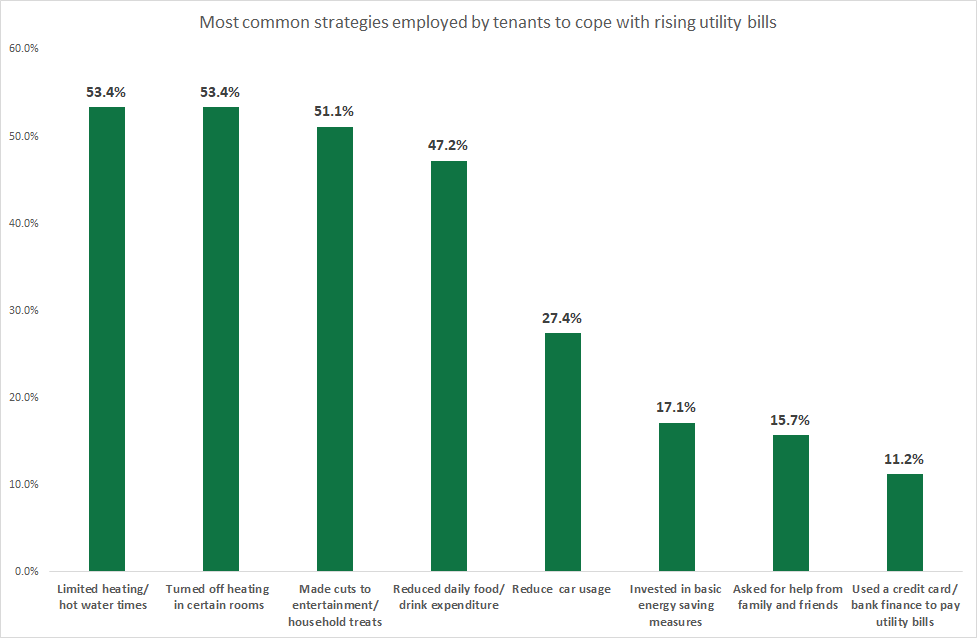
The two most common actions taken by tenants involve measures that limit energy usage:
The chart reveals that tenants reported reductions in both essential and non-essential spending:
Finally:
(Note: multiple responses were allowed for this question)
Tenants were asked whether they had experienced problems with damp, mould, or condensation. Findings showed there was around an even split between those who had (48%) and those who had not (49.5%).
Tenants who had experienced issues, were invited to comment on the extent to which these issues were influenced by rising energy bills, and the result of having the heating on for less time than usual. The same question was also put to landlords in our latest Quarterly consultation (Q1 2023).
The below graph compares the results between the landlords and tenants who had recent experience of damp or mould related issues:
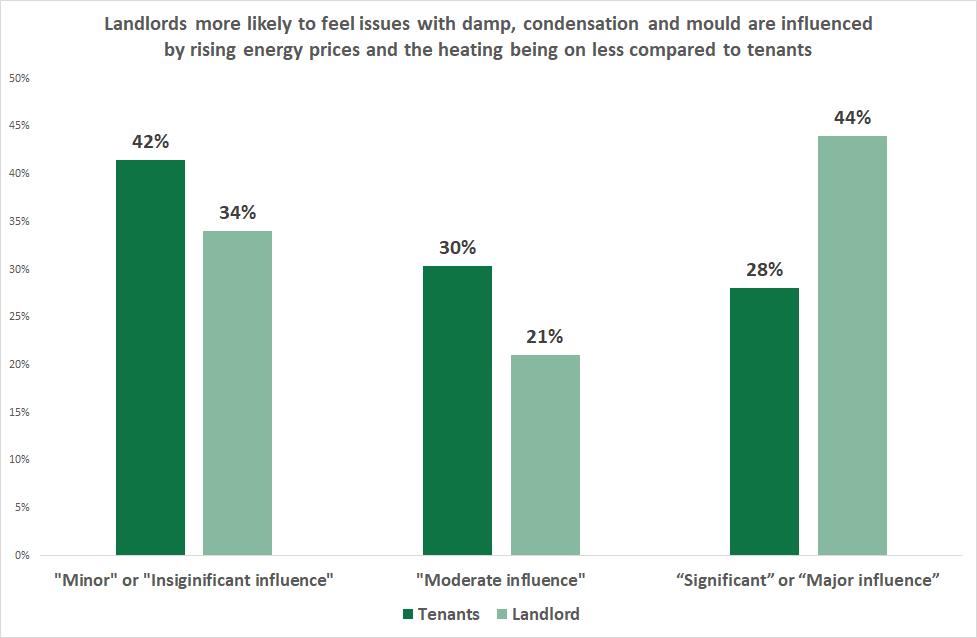
As shown in the graph, landlords were more likely to think that issues with damp, mould and condensation were in larger part a result of rising energy prices and the heating being on less frequently. The contrasting viewpoints underlines the need for public information campaigns to increase understanding of the consequences of not turning the heating on as often in a property.
The findings of this tenant survey shed light on the impact of rising utility bills on tenants' finances and the measures they have had to take to cope with this sudden shock.
The majority of tenants have been affected by rising energy prices. Tenants have employed various tactics to limit the impact of rising bills, with limiting energy usage and cuts to both non-essential and essential spending being the most common. This has had knock-on effects on the condition of rental properties. More should be done to inform stakeholders about the consequences of not having the heating on during winter.
The survey found that when tenants have had a discussion about concerns over utility costs with their landlords, most received positive responses and support. Tenants concerned about rising utility bills should talk to their landlord, the findings of the survey show that typically, the outcome of such conversations have been both beneficial and worthwhile, with the landlord placing value on the tenant relationship.