This is a heading
This is a subheading 123
this is some text which will go here
This news article is more than 12 months old and some of the information may be out of date - please see our latest news articles here.
In the Summer of 2022, the NRLA commissioned market research company DVJ Insights to undertake research on landlords across England & Wales who were not necessarily members of the NRLA. DVJ Insights conducted almost 900 on-line interviews through a questionnaire-style survey. This is the second of three summary blog posts reporting on key insights from this research.
This post focuses on how landlords may respond to mooted changes to current Minimum Energy Efficiency Standards (MEES).
In line with plans to reach net-zero carbon emissions by 2050, in September of 2020 the UK Government launched a consultation on improving the energy efficiency of rented properties.
Currently, landlords letting properties in England and Wales are required to have a minimum EPC rating of E. By contrast, the proposals - if implemented - would require a minimum EPC rating of a C. If this proposed standard is introduced, it could affect new tenancies from as soon as 2025. Existing tenancies would possibly have to be brought into line by 2028.
The Government are yet to release the outcome of the consultation. At present these are only suggested proposals and are not official policy. The longer the delay, the less likely these time horizons can be considered realistic.
In August of 2020, a month before the launch of the consultation on MEES in the PRS, the Government announced a £2 billion package to incentivise energy improvements. The Green Homes Grant allowed landlords to re-claim two thirds of up to a £5,000 investment in energy improvements.
However, a mixture of poor communication, inadequate design and eligibility issues, the scheme closed before any significant impact had been made. For more information on the Green Homes Grant please read the NRLA’s report here.
The government department overseeing MEES targets - BEIS - estimates the average investment needed for a property to reach an EPC-C to be £4,700. BEIS recognises in some cases there will be significantly higher costs.
Given how significant this change could be, landlords were asked whether they were aware of possible changes to MEES policy.
Landlords were asked whether any legislation emerging from the Government’s consultation on MEES would have a big impact on them as landlords and their portfolio.
The chart below separates responses by (i) whether the landlord holds an NRLA membership or not, and (ii) the number of properties owned.
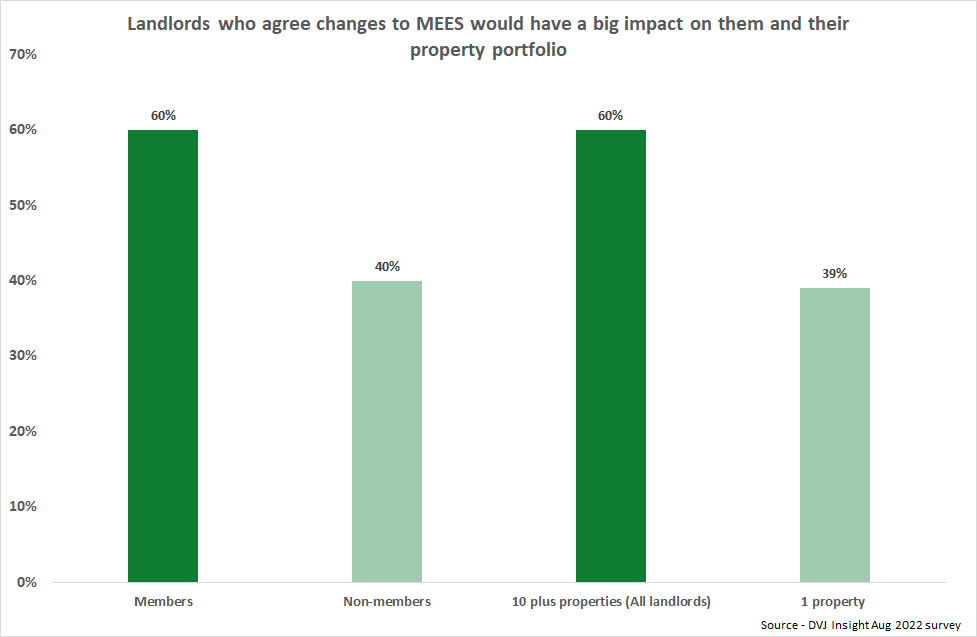
The chart shows:
Landlords indicating that any future changes to MEES would have a big impact were asked to describe why and how the change would have such an effect.
One key concern expressed by landlords was the cost of reaching EPC-C: Older properties are more likely to have a lower EPC rating and can be more difficult and expensive to improve the rating compared with newer properties.
A selection of landlords comments collected in the research are shown below:
“It will be extremely costly and punitive. There will be paltry support and grants. Also disruptive to tenants and may cause rental voids”
“I have done everything I can reasonably afford to improve my property. I will have to sell now as I cannot bring my older property up to spec”
“While it is a good idea to raise the ratings, I fear the costs of achieving them may mean letting is no longer economic”
One landlord also stated they were “not sure about the energy efficiency of my property and how it could be improved.”
Landlords who stated the proposed changes would not have a big impact were also asked why they held this belief. Examples of responses include:
“Because we only have one property.”
“All of our properties have a good rating and we will take measures where necessary if we feel that we are falling behind. Energy efficiency is important to us.”
Landlords who said the changes to MEES would not have a big impact were also, unsurprisingly, more likely to own a property that already meets or exceeds the proposed minimum EPC rating of C.
If landlords are going to be able to meet any revised MEES rating such as EPC-C, further support is critical. Responses indicate for many landlords, rather than attempt to meet the costs of upgrading a property, they will opt to sell. The overall impact then would be a loss of choice in the PRS.
If the Government were to go ahead with MEES changes as proposed, a range of incentives which stimulate landlord investment in energy efficiency is vital. The Green Homes Grant demonstrates that the [Conservative] Government of the day recognised the important role of financial support to incentivise green investment. Without funding – correctly targeted – and necessary exemptions for older properties, many landlords feel they would be unable to meet revised targets.
Further NRLA recommendations, based on the views of landlords and wider stakeholders, can be found here.