This is a heading
This is a subheading 123
this is some text which will go here
This news article is more than 12 months old and some of the information may be out of date - please see our latest news articles here.
A key theme of the NRLA’s 2021 Quarter 4 survey was accessibility. The quarterly survey presents a landlord perspective on meeting the needs of tenants and/or their family members who require specific adaptations to enable them to live independent lives.
Landlords in this survey were asked about, the type of accessibility features they have installed in their property. They were also asked about:
The number of elderly and disabled tenants accessing the Private Rented Sector continues to grow rapidly.
According to the English Housing Survey 2020/21 for example, there were 382,000 households headed by a person aged 65 and over in the PRS. This is an increase from 220,000 in 2003-04. Furthermore, the same survey found over a quarter of households in the PRS had a member who had a long-term illness or disability.
Despite a clear need for adapted properties for elderly and disabled tenant, the take up of the Disabled Facilities Grant (DFG) – grant funding used specifically for property adaptations - remains very low in the PRS. In England, only 8% of DFG money goes to the PRS.
Around a fifth of landlords (18%) in the NRLA survey stated they had made adaptations to a property at some point.
But – at present - just 7% of landlords in the survey (over 1,000 landlords taking part), stated they had tenants with accessibility needs.
Thus, among landlords who had made adaptations:
Those landlords who had not made any kind of adaptions were asked why they had not done so.
Just 5% of landlords in this group believed the cost of making those adaptations was prohibitive.
Other than a perceived lack of demand, the other key concern landlords voiced was the impact making adaptations may have on their property.
Are adaptations too expensive to install? Will they damage the property? How much will it cost to remove the adaptations at the end of a tenancy?
These are all questions which landlords, not unreasonably, require addressing – that is if they are ever approached to make such changes.
Landlords were asked what policy tools could be used to increase the supply of adapted housing in the PRS.
The chart below outlines (from a longer list) the key features landlords feel would be most likely to stimulate an increase in the number of PRS adapted properties.
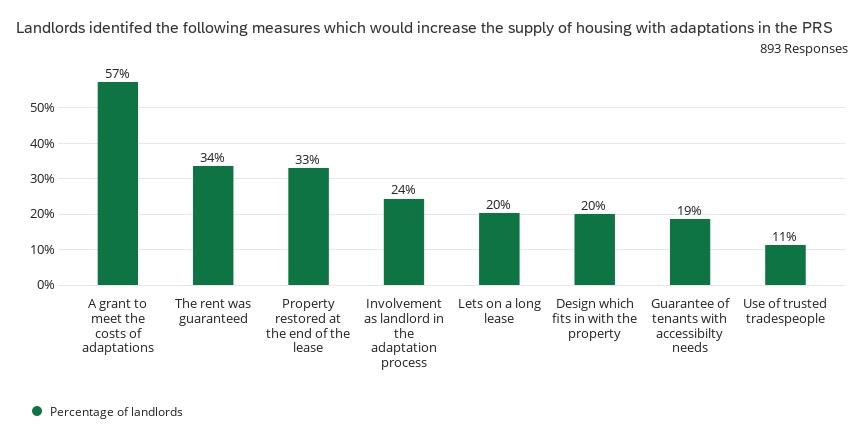
In most of the UK, landlords with tenants who require adaptations to their rental properties can apply for funding. This is in the form of the Disabled Facilities Grant (DFG).
In England the DFG covers adaptations up to £30,000 (£36,000 in Wales.) However, some local authorities offer additional top up discretionary funding to pay for adaptations that are above the £30,000 threshold.
There is no need for landlords to take a financial hit.
Why isn’t this grant being used more by landlords? Because most have never heard of it!
Well, it is certainly a start:
Local initiatives which seek to work with landlords and increase the supply of private rented properties that have adaptations already exist.
Landlords were asked about the potential of local initiatives and add value to the DFG and ensure a long-term supply of homes to a stream of tenants who require specific adaptations.
Some landlords did state they would be willing to let a third party take control of the entire process:
Many landlords wished to maintain certain rights and oversight to their properties should they participate in a local authority-led scheme.
For example landlords stated they wish to retain the right to:
Landlords are reluctant to install adaptations for tenants or the family members of the tenant. There are three key barriers:
Analysis of the above indicates a clear market failure exists: the supply side of the rental market is uninformed about the true level of demand.
As a result a landlord's expectation is that they would have to meet (1) the cost of adapting the property and then (2) repurpose that property at the end of a tenancy. This makes it uneconomic to make adaptations. This is perfectly rational behaviour.
The Disabled Facilities Grant provides a funding mechanism to help meet costs. But the existence of the grant is itself not enough to address market failure and the asymmetry of market information between landlords and would-be tenants.
The lack of awareness of such a grant reinforces the evidence that market failure is an issue here. The grant itself will not communicate to landlords the true level of market demand.
Facilitators - here local authorities - have attempted to mediate and encourage landlords to participate in schemes designed to increase the supply of adapted properties.
However terms and conditions of such schemes need a critical re-evaluation. Landlords need to feel like active partners in these initiatives. Whilst some landlords are willing to let a third party take control of the entire process, there is a general reluctance to be involved in a scheme which may involve relinquishing significant levels of control and responsibility.
More must be done by local authorities to (i) incorporate the above observations into "best practice" models and (ii) better promote best practice schemes to the wider landlord community.
In order to address landlord concerns, we have produced landlord guidance designed to support landlords and highlight the key advantages of adapting properties.
We are also working with five pilot local authorities to foster positive engagement between local authorities and private landlords.
More details on this topic are available elsewhere on the NRLA website.