

This is a heading
This is a subheading 123
this is some text which will go here
This news article is more than 12 months old and some of the information may be out of date - please see our latest news articles here.
The General election is fast approaching. How are landlords deciding where their vote will be cast? Should the political parties be actively campaigning and trying to get the votes of landlords – or have landlords already decided?
The NRLA are interested not in who – party wise - landlords are voting for. But rather how important policies which will have an impact on the PRS weigh on the minds of landlords in deciding how to vote.
The data presented comes from the NRLA’s regular quarterly member consultation. The fieldwork was undertaken in Quarter 1 2024 during March and early April 2024.
In total, 685 landlords took part in this research. All interviews were conducted on-line.
In the main, yes. However, many landlords are open to be persuaded. Chart 1 shows how NRLA members are thinking about their vote. For comparison we asked the same question as part of the NRLA’s recent ‘All-landlord survey’, which runs twice a year.
For this wider all-landlord survey, polling company YouGov undertook the fieldwork. This fieldwork was also conducted in March 2024. (Note that 9% of this sample are members of the NRLA). For this survey, 1,002 landlords took part.
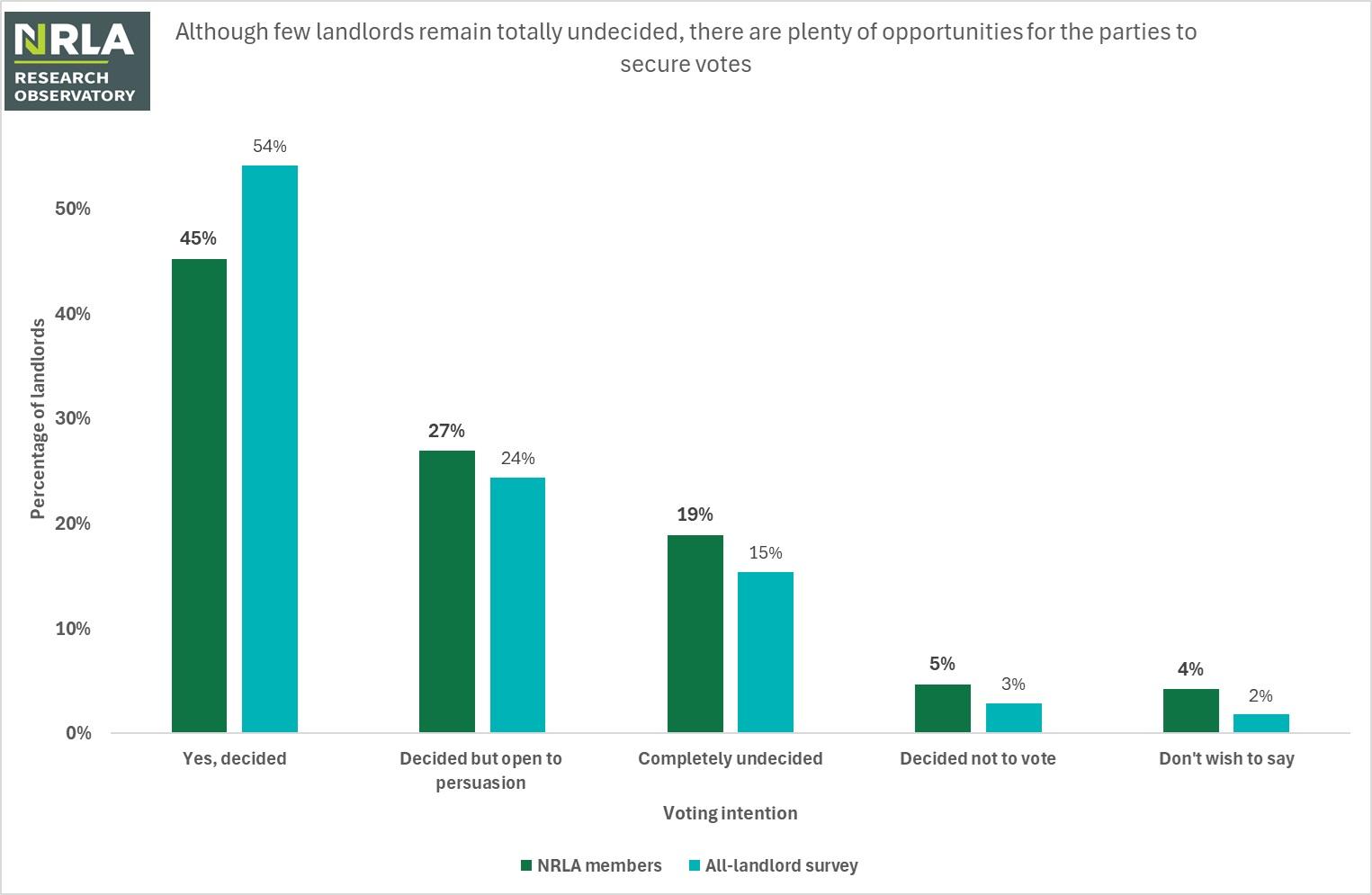
From the above chart, there are two key points:
The NRLA asked landlords what key policy areas would determine how they would vote. Each landlord selected upto three key policy areas or other voting determinants which they felt were important. Note the question specified "...other than the PRS".
The chart below shows the “top 10 policies” which will influence landlords. By coincidence, these were also all policy areas which were identified as “key” by more than 10% of landlords.
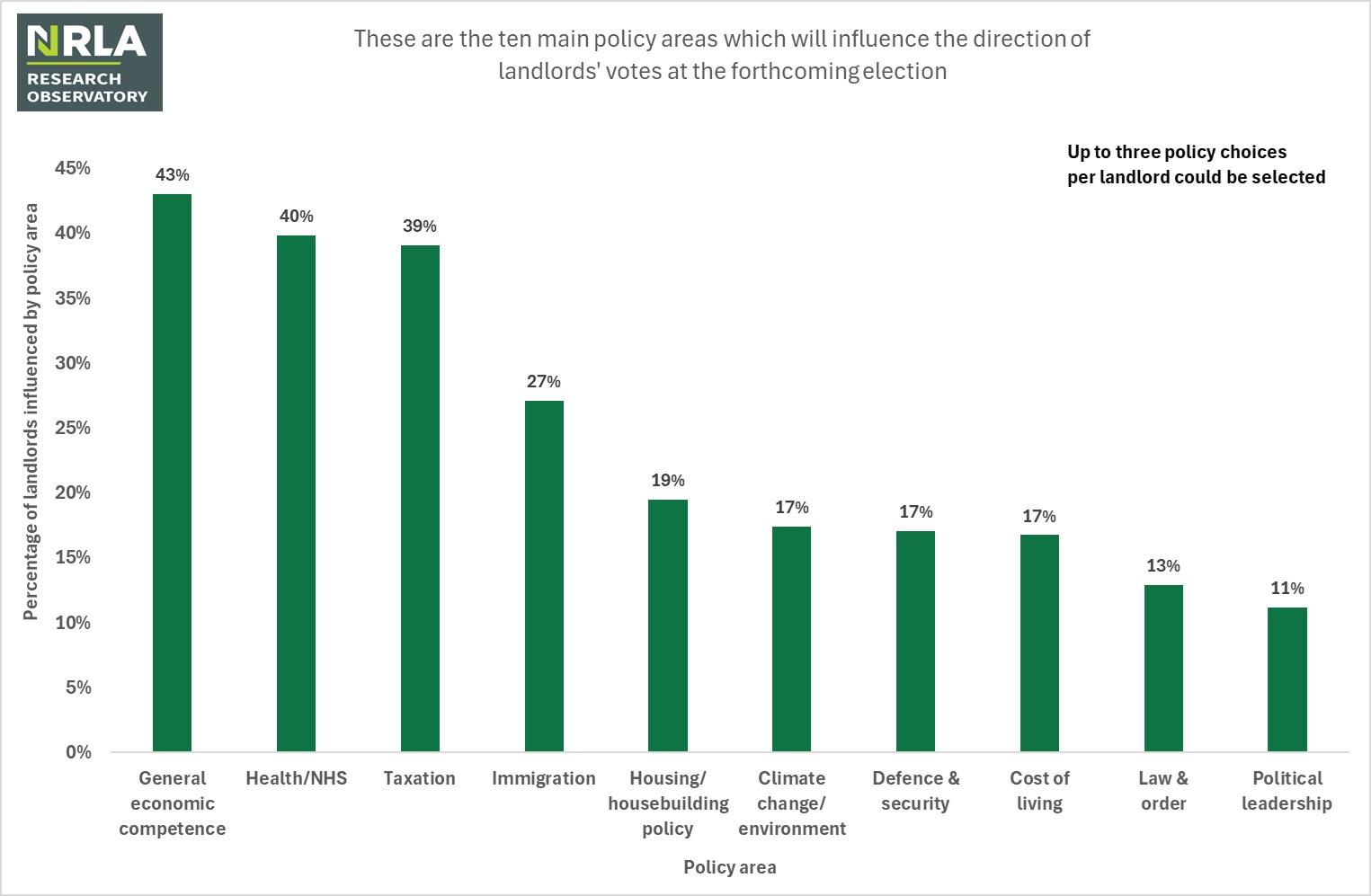
The chart above shows the following issues dominate landlord-voter thinking:
These three issues are by some distance ahead of immigration with other policy areas tailing off in importance.
A couple of points to note:
To compare findings with the wider population, the YouGov policy issue tracker for the period when this landlord fieldwork was undertaken provides a useful benchmark. The key observation is that the views and policy priorities of the landlord community is not dissimilar to that of the wider voting population:
Finally, note that “Housing policy” was selected by similar proportions of participants in the NRLA landlord poll and the wider voter policy tracker – 25% of the broader YouGov poll cited housing and 20% of NRLA members.
Landlords were asked whether policies towards the PRS specifically would be influential when deciding where their vote would be cast.
The fieldwork took place before the election was even announced, let alone the manifestos were published. However, both the Renters’ Reform Bill (RRB) and the reaction to it did provide some information about the likely priorities of the main parties:
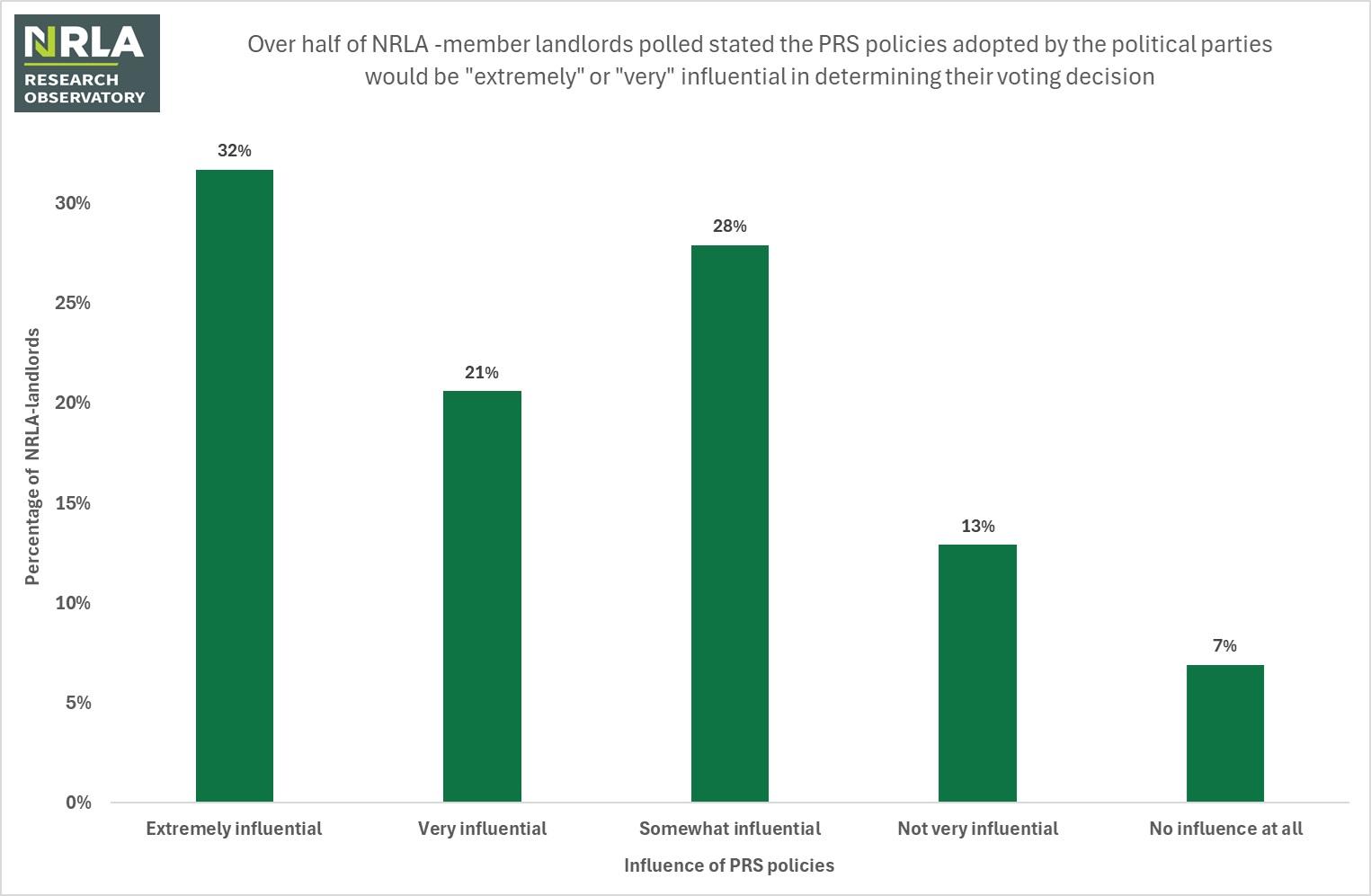
The chart shows how influential a clear PRS policy could be in persuading landlords to support a particular party.
Note too that:
The NRLA polling shows that landlords are a constituency whose votes were very much up-for-grabs in what turned out to be the run-up to the General Election. Whilst landlords have no specific or unique policy preferences which makes them distinct from other voters, a substantial portion will be swayed by the policies political parties adopt towards the Private Rented Sector.
Landlords are a relatively small constituency – numbering probably between 1.25-2.5m voters across the UK – and they are also dispersed across the country.
However, when compiling their manifestos, political parties should reflect on their PRS policies: (i) because over a million potential votes are not to be sniffed at and (ii) maintaining the confidence of landlords post-election will be an important part of addressing the housing brief whoever forms the next government.