This is a heading
This is a subheading 123
this is some text which will go here
This news article is more than 12 months old and some of the information may be out of date - please see our latest news articles here.
The English Housing Survey (EHS) is an annual national survey that offers insights and data regarding England's housing conditions. It explores various topics such as housing quality and safety; energy efficiency; household demographics; ownership and rental statistics; and the physical state of residences.
Serving as a critical resource for government decision-making, the EHS aids in tracking housing trends, shaping housing policies, and tackling issues related to housing and living standards. The NRLA frequently references it among various sources for information.
The 2021-22 English Housing Survey data was collected during the COVID-19 pandemic. This meant that face-to-face interviews were replaced with telephone interviews and internal inspections of properties were instead replaced with external inspections.
Currently, the survey is undertaken by the Department for Leveling Up Housing and Communities, although the overseeing department may vary over time.
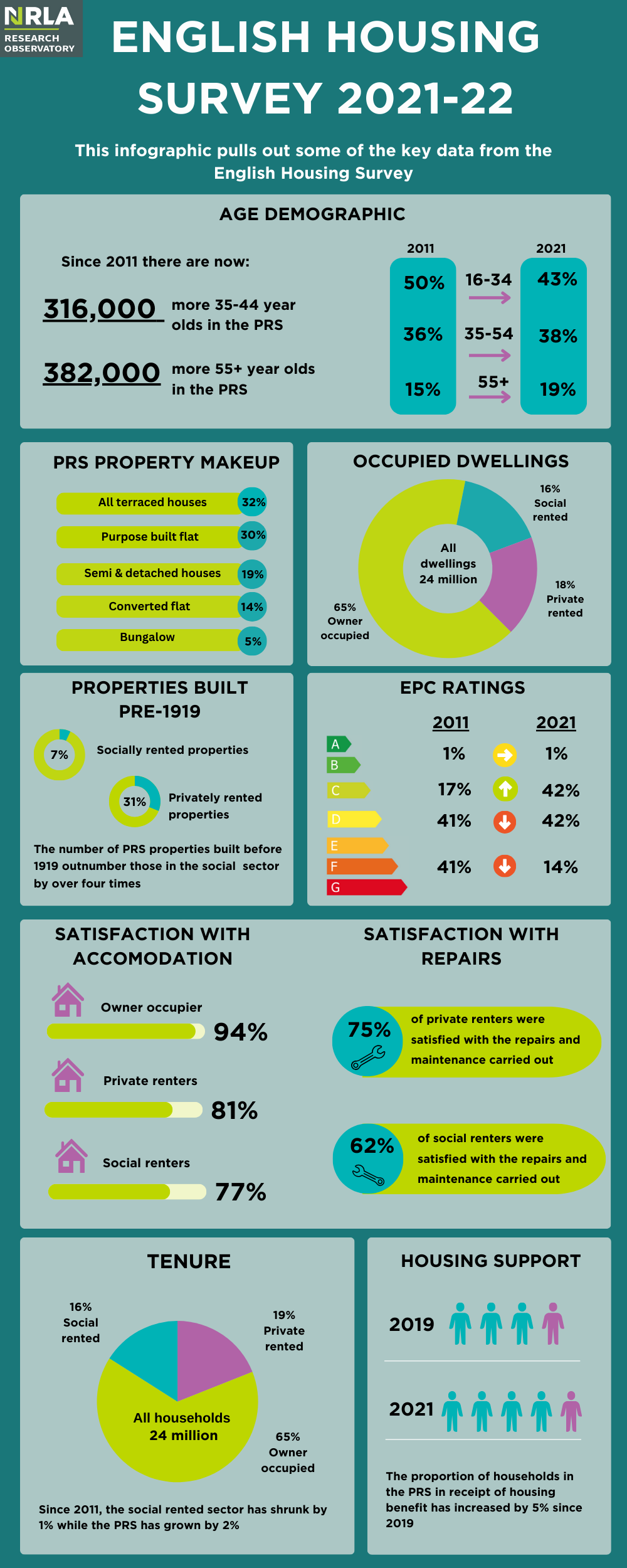
In England, owner-occupied homes continue to represent the majority of housing, encompassing 65% of all households, or approximately 15.6 million.
A substantial portion (almost one-in-three) of the PRS consist of properties built before 1919.
This a figure that is four times higher than the social sector (7%).
Older dwellings are among the least energy-efficient. These dwellings often require substantial investment to meet minimum energy efficiency standards.
The data shows landlords in the PRS have been investing heavily in energy efficiency measures:
The key challenge will be moving properties currently rated 'D' into a more energy efficient band.
The profile of tenants in the PRS is slowly but surely becoming more age-mixed, with the proportion of older tenants rising.
Looking at the experience of tenants within the two rented sectors, tenants within the PRS are most satisfied with their accomodation and repairs and maintance compared to the social sector.