This is a heading
This is a subheading 123
this is some text which will go here
This news article is more than 12 months old and some of the information may be out of date - please see our latest news articles here.
At the end of 2024, the NRLA undertook research focusing on how landlords have diversified from standard residential letting models.
Typically, NRLA surveys show 3-6% of members have holiday/short-term lets as part of their portfolio. This has been a consistent result in the NRLA’s quarterly surveys. There is no clear trend into – or out of – this market by our members.
The NRLA sought the views of landlords on two further approaches to diversification:
The Labour government have a manifesto commitment to building 1.5m homes before the next General Election. Many NRLA members have had experience in bringing forward projects which increase the supply of housing:
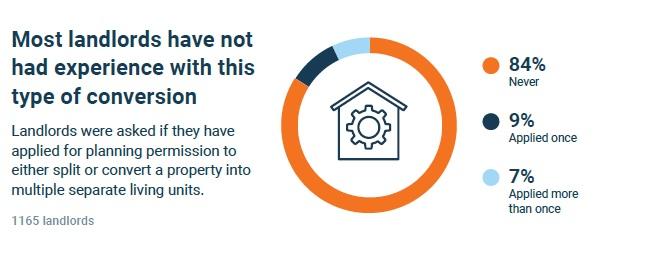
In this consultation, 16% of all landlords surveyed (see above) stated they had - at some point - applied for planning permission to “either split or convert a property into multiple, separate (self-contained) living units”.
(From the responses of these landlords, we estimate survey participants have been involved in the creation of over 350 additional housing units)
We asked those landlords who had experience of delivering housing projects to share their knowledge across three areas:
With 88% of landlords from this, admittedly small group, finding success with at least one application (and over three-quarter (76%) successful with all applications), the planning process is as much a hoop as barrier to a determined entrepreneur.
Among this group of landlords:
The responses suggest that while the planning process does present hurdles, for determined entrepreneurs, these hurdles do not necessarily terminate construction projects.
However, notwithstanding the above observation, landlords say the system is too slow, bureaucratic, and inconsistent. Under-staffing and excessive red tape creating major barriers. Smaller developers struggle the most and want a simpler, faster, and fairer process.
The key challenges identified by landlords include:
The report contains more details on which groups of landlords are more, or less likely, to be involved in a project. Note that there is no link between:
With legislative changes and increasing regulation, some landlords are questioning their long-term future in the sector. Is commercial letting a way of hedging against these risks OR is the desire to break out into commercial lets a sign of confidence across all rental markets?
Our most recent polling finds 13% of respondents presently let at least one commercial property as part of their portfolio.
The potential advantages of commercial letting over residential include:
However, commercial lets also feature:
Most landlords (72%) have no intention of diversifying into the commercial letting market - although almost a third of these (26%) stated they had given the option some consideration.
The NRLAs look at that 13% of residential landlords who also let commerical property includes the following observations:
The study also highlights:
The NRLA asked landlords who had invested or considered investing in commercial property whether they felt commercial property could become more important in their portfolio in the future:
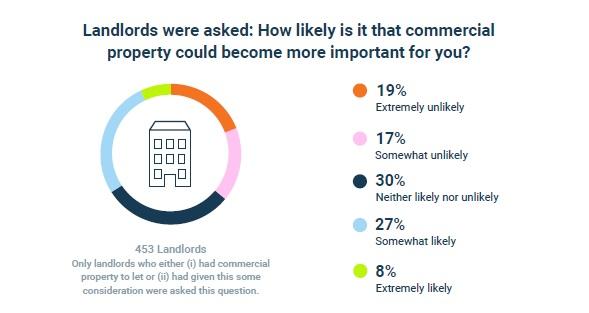
There is an even split – roughly 1/3-1/3-1/3 – between landlords feeling it either likely, unlikely, or unsure that commercial property will grow in importance as a component of their portfolios.
This sub-sample includes landlords who have previously considered commercial letting but not committed to the idea. For those who have invested, investing more deeply into this commercial market is even more likely (although numbers in the sample are starting to get smaller).
Finally, the following two groups both stated commercial letting would grow in importance within their portfolios over time:
The 2024 Quarter 4 In Focus considered two ways in which landlords could diversify and spread risk away from residential letting.
Although numbers are small, around one third of property developers also let commercial property. However, the confidence level of commercial property investors is more likely to be higher than the norm than that of property developers.
There are two tentative (because of the small numbers) conclusions:
The policy implications therefore differ between encouraging investment in commercial letting to that of property development: