This is a heading
This is a subheading 123
this is some text which will go here
This news article is more than 12 months old and some of the information may be out of date - please see our latest news articles here.
The issue of rent controls in the Private Rented Sector (PRS) has considerable policy interest. Ongoing concerns about affordability in housing have been compounded by rising inflation and a wider cost-of-living crisis. Among politicians, rent controls appear to be a panacea:
Although rent control policies aim to provide stability and affordability for tenants, analysis suggests that rent controls are a poor instrument to achieve these goals and often result in unintended consequences. This blog post focuses on the views of landlords towards rent controls and what the impact of such controls would likely be.
Rent control policies have evolved over time and can be split into three broad categories:
i) First generation rent controls – This entails a form of 'hard' control in which rents are fixed and remain frozen. Put simply this means rents have a maximum price ceiling.
ii) Second generation rent controls – rent increases are limited to a set percentage or pegged to inflation.
iii) Third generation rent controls – these allow initial rents (i.e., new tenancies) to be freely set by landlords or with a very light restriction but limit rent increases within tenancies.
Compelling evidence demonstrates that where rent controls policies have been enacted in regions around the world, they have failed to offer an effective solution to address housing affordability challenges.
Instead of tempering rising rents, research has shown they fail to address the underlying issues of affordability. Unintended consequences include:
This blog post draws on findings from a YouGov landlord poll of over 1,000 landlords across England & Wales. The survey was commissioned by the NRLA in Winter 2022 across England & Wales. Around 10% (9.6%) of these landlords were members of the NRLA.
Among the topics discussed in the survey was landlord sentiment towards second and third generation rent control. Landlords were asked to comment on the following three scenarios:
Scenario 1 - Rents are fixed by an external authority both during and between tenancies (second generation)
Scenario 2 – Rent increases are pegged to inflation both between and during tenancies (second generation)
Scenario 3 – Rents for new tenancies are set by landlords but subsequent increases are limited to inflation or set by an agency (third generation)
Landlords were asked how they would respond to each rent control scenario. For each scenario, the largest grouping of landlords stated the rent control measure would not make any difference. These landlords will continue to let property as before under these rules. There are however some differences in the sizes of this group in the respective scenarios - see Figure 1 below:
The above results show that Scenario 1 received the most pushback from respondents.
Scenario 1 and Scenario 2 are similar in that they restrict landlords from setting the rent at any point. The key difference is that landlords are even less receptive to the idea of rents being set by an external authority compared to a simple inflation-based rent peg.
Those landlords who WOULD make a change were asked what changes they would implement. This means that the percentages below reflect a larger number, as well as a larger proportion of landlords for Scenario 1 (where Figure 1 shows a far smaller proportion of landlords "carrying on" under the proposed regime).
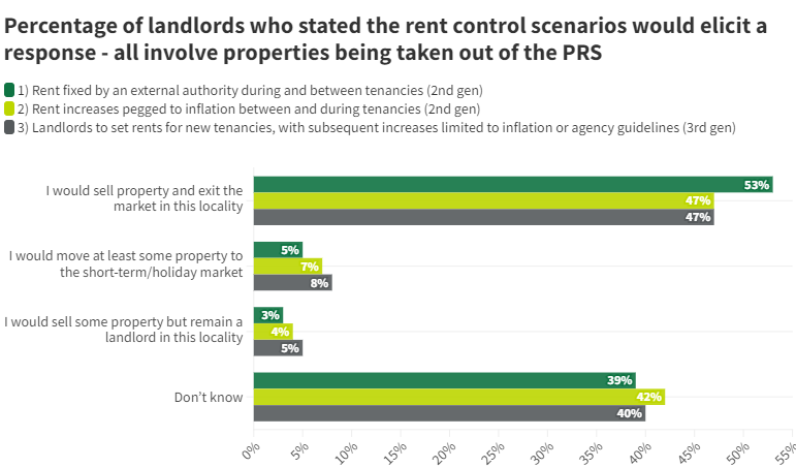
Chart 1 shows how those landlords who would change behaviour could react to the scenarios posed above. It is Scenario 1 in which one would anticipate the highest proportion of landlords selling all their properties in that locality and exiting the market.
If those responding "carry on as before" are re-included, the results still indicate a significant impact on the PRS:
Furthermore, as Chart 1 above shows, a large proportion of landlords remain "Undecided". If even a few of this undecided group act to reduce their portfolios in the rent control area, the problem of supply is exacerbated.
As a response to affordability challenges posed by the impact of Covid-19 and the wider cost-of-living crisis, Scotland introduced temporary rent controls.
Chart 2 below shows that rent increases in Scotland have followed the same trend as England – even though there are no rent controls in England. Note that the recorded rise in Scotland’s rents in this chart pre-date the April 2023 mandated increase.
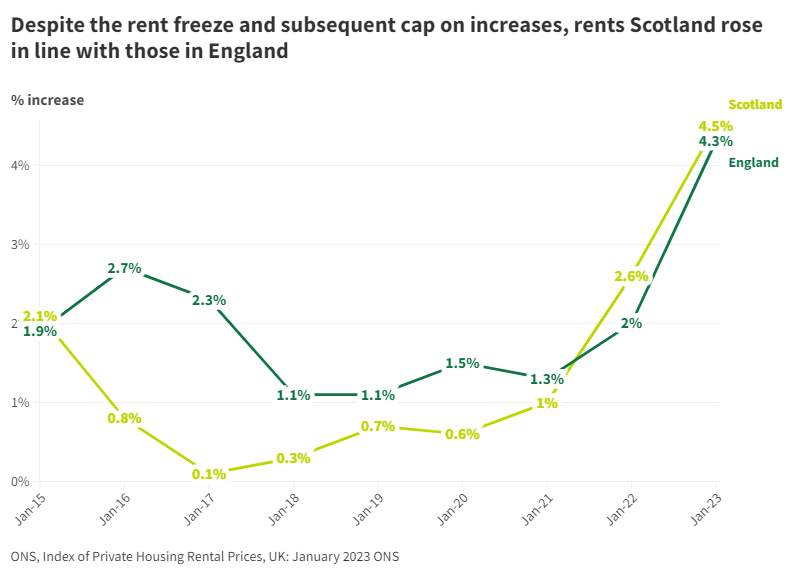
While rent controls appear to many as a simple solution to housing affordability challenges, they come with uninteneded consequences. Economists have presented detailed evidence to show rent control policies could lead to reduced market supply – as well as a range of other housing and labour market problems.
This YouGov market research underlines these supply-constraint concerns: if landlords are unable to meet rising costs, many will reduce their portfolios, exacerbating current PRS-supply difficulties. The result of rent controls will have significant consequences for the balance between supply and demand: irrespective of the chosen rent control model.